

I’ve paid for three of these and used one. The other two sat on the second screen of my phone until a renewal email showed up in February, and I did the math on what I’d spent per session. It came to about eleven dollars a listen. Nobody reviewing a Christian meditation app mentions that this is the usual ending.
Best in general is a useless category here. The one worth paying for is the one you’ll still open in March, after the newness wears off and before anything has visibly improved. Seven things I check, in order.
The field, briefly. Hallow is Catholic by design and much the biggest, Abide is evangelical and built around sleep and anxiety, and Glorify looks and paces like Calm with worship music attached. All three are competent, which is why every review site produces the same ranking.
Live on the free tier for two weeks
Free content only, no trial, no card. Some give you a real daily session plus a rotating handful of others, enough to build a habit on. Others hand you a sampler with a lock icon on everything that looked good in the screenshots. A free tier that only shows you what praying could look like if you paid is a trial in a costume.
Somebody’s tradition is already baked in
Hallow gives you the Rosary, the Divine Office, lectio divina, the daily Mass readings. Grow up Baptist and you’ll find that either beautiful or foreign, and I can’t tell you which from here. Abide and Glorify are broadly evangelical, a position rather than a neutral setting. None of it is a defect. It’s only a problem if you find out after the $60 has left your account.
Does it ever point you out the door?
This is the one I care most about. Ask whether the app sends you anywhere at all, to a passage, a book, a church, a person who should get a phone call, or whether every path loops back into more of its own audio.
An app that keeps you inside forever is doing what its retention numbers reward. Jesus told people to go into a room and shut the door (Matthew 6:6, ESV), and the good ones eventually help you do that without them. Around month three, ask if you’re praying more or listening more.
Sleep and prayer are different products
Awake at 2 a.m., you want a Christian meditation app for sleep with long, boring tracks and a narrator who never crescendos. A daily Christian prayer app wants fixed anchors at set times. Grabbing the sleep app for morning prayer is how people decide meditation doesn’t work for them.
For stress, be honest about what you’re asking for. A 5 minute meditation before bed can settle a wound-up evening. It won’t touch a job that’s making you sick.
Where the mindfulness came from
Guided mindfulness meditation techniques are everywhere here, sometimes with a verse laid over the top. Body scans and slow breathing aren’t pagan, and Christians have used posture and breath for centuries. Watch what the practice does with your attention. Emptying your mind and attending to God are separate assignments, and an app treating them as the same has stopped thinking about what it sells.
I’ll admit the line gets blurry, and I’ve never fully settled where it sits. What I do know is that “Be still, and know that I am God” gets used to sell calm, when the rest of Psalm 46:10 is about God being exalted among the nations. Closer to a command to quit striving against him than an invitation to relax.
The phone is the part nobody can fix
Every one of these delivers Christian audio meditation through the same rectangle that holds your work email. Airplane mode before you start is the smallest habit with the biggest return, which is why offline downloads matter more than feature lists let on.
Price, and the way out
Annual plans run roughly $40 to $70. Check today’s number rather than trusting mine. Then find the cancellation path before you subscribe, because an app that buries it is telling you how it intends to keep you. Monthly first, always. Go annual after eight straight weeks, not before.
Our own app, held to the same list
We make one of these, so read everything above knowing I have a stake in it.
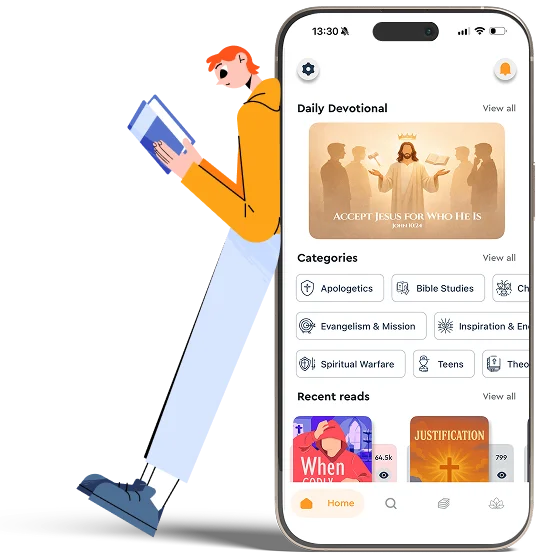
Holy Reads has prayers and meditations through the Psalms, read by voice actors, made for putting the day down at night. Scripture carries the session instead of ambient sound with a verse floating on top. We’re evangelical and the Psalms do the work, so if you came for the Rosary, Hallow is your app and I’d rather say so than take your money.
On the test I said I cared most about, we point out the door on purpose. The meditations sit beside 20-minute summaries of the Christian books these practices come from, and the point of a summary is that you go read the book.
Where we’re thinner: if you want a big library of ambient sleep tracks and bedtime stories, Abide has more. Buy the one that fits.
One thing no app repairs. If anxiety is running your week, meditation to relieve stress and anxiety supplements care and never replaces it. See a doctor.
What to do tonight
Pick one app. Free content only, same time each night, fourteen days, end date on a sticky note so you’re not guessing. Open it eleven nights out of fourteen and pay for a month. Open it four nights and delete it, then try the next one having spent nothing.
Start those fourteen days with us if you like. Download Holy Reads, open the Psalms and meditations tonight, and let a psalm read slowly be the last thing you hear instead of your own arithmetic about tomorrow.