

Skepticism is easy; evidence is hard. Most people believe what they believe because of tradition or feeling. Lee Strobel wasn’t most people. As the award-winning legal editor of the Chicago Tribune with a Yale Law degree, Strobel was a man of cold, hard facts.
When his wife converted to Christianity, he didn’t just get annoyed—he went to war. He spent two years using his investigative skills to dismantle the New Testament. He didn’t find the fraud he was looking for; he found a case so airtight it changed his life. The Case for Christ proves that blind skepticism is lazy, while real investigation is transformative.
Historical Reliability: The New Testament vs. Ancient History
Historical accuracy in the ancient world depends on three variables:
- The number of manuscript copies.
- The time gap from the original events.
- The consistency of the content.
Any The Case for Christ book summary highlights a staggering statistical reality. While Homer’s Iliad has about 650 surviving manuscripts, the New Testament boasts over 5,000 in the original Greek alone. The gap between the events and the records? In historical terms, it’s a heartbeat. If a critic rejects the Gospels based on “unreliability,” they must also discard almost everything we know about Caesar, Plato, and Aristotle.
Forensic Evidence: Debunking the “Swoon Theory”
Strobel didn’t just study parchment; he studied biology. He interviewed physicians about the physical reality of the crucifixion to test the “Swoon Theory”—the idea that Jesus merely fainted and revived in a cool tomb.
The medical data, however, points to a definitive end:
- Hypovolemic Shock: Massive blood loss leading to heart failure.
- Asphyxiation: The mechanical exhaustion of the lungs.
- Hematidrosis: A rare medical condition where extreme stress causes blood to seep into sweat glands.
This isn’t theology; it’s forensics. Understanding this shift from “story” to “data” changes the entire conversation. Facts are stubborn; they don’t bend for convenience.
The Math of Prophecy: 1 in 100 Quadrillion
Mathematics doesn’t lie. Strobel’s investigation highlights the probability of one person fulfilling just eight specific ancient prophecies.
The Odds: 1 in 100,000,000,000,000,000.
To visualize this, imagine covering the state of Texas in silver dollars two feet deep, marking one coin, and asking a blindfolded person to find it on their first try. The Case for Christ isn’t asking for blind faith; it’s presenting the overwhelming weight of probability.
How to Digest “The Case for Christ” in 15 Minutes
Reading 300+ pages of investigative journalism is a challenge for busy professionals. However, these facts are too significant to ignore.
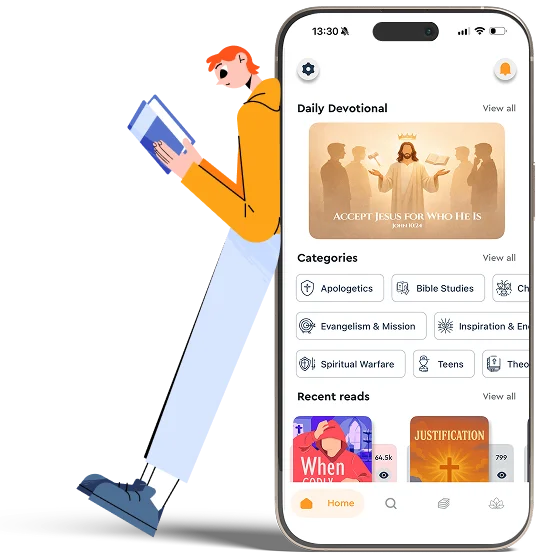
Our app, Holy Reads, turns this deep-dive investigation into a 15-minute power session. Whether you want to read a concise summary or listen to The Case for Christ audio during your commute, the insights are ready when you are. We even provide short-form video breakdowns of complex timelines and archaeological charts.
Reaching a Verdict: The Legal Standard for Truth
Most people get stuck in a “what if” loop. Strobel solved this by applying the same legal standard used in high-stakes courtrooms. He identified a single logical pivot point that makes Western civilization either a brilliant truth or a massive hoax.
If you are ready to apply that logic to your own doubts and see the “closing arguments” of the most famous apologetics case in history, we can help.
Don’t stay in the dark. To access the complete legal framework and the execution steps for a life-changing verdict, download the app today.