

You already have a Bible app, a podcast queue, and a prayer reminder on your phone. None of it is making you more like Christ. So when someone tells you AI is the next tool that will deepen your faith, you should at least pause before downloading anything.
That skepticism is worth holding onto. Not because technology is bad, but because spiritual shortcuts have a long history of producing shallow Christians.
What AI Can (and Can’t) Do for Your Faith
AI is genuinely useful for some things. It can summarize a theologian’s argument you don’t have time to read in full. It can generate questions for a Bible study you’re leading. It can explain a Hebrew word’s range of meaning, or give you background on the cultural context of a passage. These are real, practical gains.
What it cannot do is pray. Not actually. It can produce the shape of a prayer, the grammar of devotion. But prayer is communication with a Person. It requires you to show up, not a model trained on 10,000 devotionals.
AI has no skin in your sanctification. It doesn’t know that you’ve been avoiding that conversation with your father for three years, or that your anger is the thing Scripture keeps pressing on. It responds to what you type. Your soul is more complicated than a prompt.
Treat AI like you treat a concordance. Useful. Limited. Not a pastor.
The Danger of Outsourcing Your Soul
Here is the pattern to watch for: convenience becomes a substitute for formation.
You use AI to write your journal entry. Then to summarize your devotional. Then to generate a prayer for a situation you don’t want to sit with long enough to pray about yourself. Each step feels like efficiency. Each step is actually distance.
Spiritual formation is not about acquiring information. It’s about being changed. And being changed requires friction, time, and presence before God. The Psalms were not efficient. They are raw, repetitive, and uncomfortable. That’s what makes them formative. Psalm 13 doesn’t resolve quickly. It sits in lament, then turns. That turn is the work. You cannot automate it.
The risk with AI and faith is not that it will convince you to stop believing. It’s that it will let you feel spiritually productive while doing nothing that actually costs you anything.
Tools vs. Teachers: Keeping AI in Its Proper Place
There is a long tradition of Christians using tools to grow in faith. The printing press put Scripture in ordinary hands. Commentaries made centuries of scholarship accessible. Audio Bibles let long-distance commuters memorize entire books.
AI fits into that line. A tool. Not a teacher.
The difference matters because teachers have authority, accountability, and relationship. Your pastor knows what you said three months ago. A spiritual director holds your history. A mentor can tell when you’re lying to yourself. AI cannot do any of this. It has no stake in whether you actually grow. It will affirm whatever you want affirmed if you phrase the question correctly.
This is why community is not optional for digital discipleship. The Church is not one feature among many. It is the body in which formation actually happens. Use AI to go deeper into a passage before Sunday. Do not use it to replace the conversation you could have had after the service.
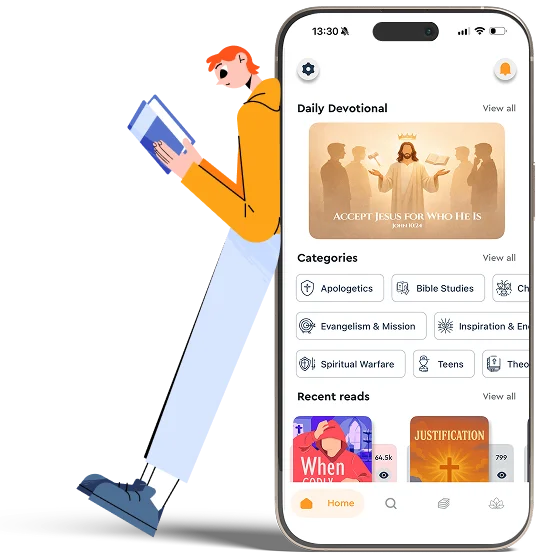
If you want a tool that respects that line, Holy Reads gives you access to the key ideas from serious Christian books, fast enough that you can actually engage with them before your next small group or sermon prep session. It handles the summarizing so you can do the thinking.
How to Use AI Without Letting It Use You
Start with a rule: AI is for input, not output.
Use it to find information, get context, or understand an argument. Do not use it to generate your prayers, your reflections, or your conclusions. The moment AI is writing what you think about God, you have handed over the thing that was supposed to be yours.
Second, notice what it costs you nothing to do. If a spiritual practice requires no silence, no discomfort, and no waiting, it is probably not forming you. That is not an indictment of technology. It is a question worth asking of anything you are doing in the name of faith.
Third, protect your attention. Every tool competes for it. The spiritual life runs on attention. Lectio Divina, the Daily Office, contemplative prayer — all of them require you to be actually present to what is in front of you. An AI assistant running in the background is not neutral. It is another claim on where your mind goes.
Faith and technology in 2026 are not opposites. But the faith that survives technology will be the faith that refuses to let convenience make the decisions. Use the tools. Keep your hands on the wheel.